


 Welcome
to the Locomotor Ecology and Biomechanics
lab. Our research is about
understanding how organisms get to be built the way they are built, and the
consequences of their design for patterns of resource use, interactions with
other species, and for patterns of evolution.
Welcome
to the Locomotor Ecology and Biomechanics
lab. Our research is about
understanding how organisms get to be built the way they are built, and the
consequences of their design for patterns of resource use, interactions with
other species, and for patterns of evolution.
We use an ecomorphological approach that merges studies of functional morphology
(lab based) and movement biomechanics (zoo based) that together determine the
effect of morphological variation on performance, with biomechanical
field-studies of animals in their natural habitat, to determine the effect of
performance on actual patterns of resource use. Our overall aim is to elucidate
the basic physical rules governing how biological structures operate;
identifying physical constraints on what organisms can do, evaluating which
structural characteristics affect performance, and analyzing the mechanisms
responsible for the effects of morphological differences on performance.
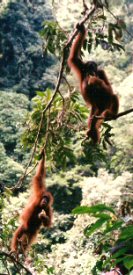
One of our primary focuses is the locomotor ecology of arboreal mammals. For
arboreal animals of large body mass, such as the great apes, the branches and
lianas that are available for locomotion are a key resource, and the ability of
animals to utilize these supports without falling or expending excessive energy
underlies the success of their foraging, reproductive and predator avoidance
strategies.
Further details about out lab can be found by following the links
on the left hand menu
